
Alternatives To Effort Reporting

ALTERNATIVES TO EFFORT CERTIFICATION/REPORTING
In January of 2016, NCURA funded a research project to establish a cohort of universities to develop an effective model policy for alternatives to effort reporting in compliance with 2 C.F.R.§200.430(I). The purpose of this project was to establish a nationally recognized cohort of universities to develop efficient and effective model policies, procedures, and practices designed to reduce administrative burden for both faculty and the institution, minimize audit risk, and most importantly, facilitate research within an ethical and appropriate compliance framework. The Cohort established continues its work to help refine standards for compliance developed, the implementation examples and tools for institutions transitioning to effort reporting, and collecting research data to analyze the impact realized at institutions that have transitioned away from traditional effort reporting methodologies.
Institution Cohort Members
Industry Service Providers
Huron
Point Consulting Group
Paul Coleman
Maximus
Cayuse
MyFedTrainer
Member Institutions
Arizona State University
Arkansas Tech University
Auburn University
Augusta University
Ball State University
Blood Research Institute
Bloodworks Northwest
Boston College
Boston VA Research Institute
Buck Institute for Research on Aging
California State University San Bernardino
California Institute of Technology
Campbell University
Carthage College
Case Western Reserve
Cedars Sinai Medical Center
Chapman University
Children's Healthcare of Atlanta
Children's Hospital Medical Center of Akron
Christopher Newport University
Clark Atlanta University
Clarkson University
Cleveland Clinic
Colby College
Colorado State University
Cornell University
College of Charleston
Dartmouth College
Embry-Riddle Aeronautical University
Emory University
Ferris State University
Florida Polytechnic University
George Mason University
Georgia College & State University
Georgia Institute of Technology
Georgia Southern University
Georgia State University
Georgia Tech University
Hawkeye Community College
HudsonAlpha Institute for Biotechnology
Indiana University
International Computer Science Institute
International Computer Science Institute
Jackson Laboratories
Kent State University
Klein Buendel, Inc.
Lehigh University
MassBay Community College
Mayo Clinic
MD Anderson Cancer Center
Memorial Sloan Kettering Cancer Center
The MetroHealth System
Mid-State Technical College
Middle Tennessee State University
Montana State University
New York University Langone Health School of Medicine
New York University
Northeastern University
Northern Arizona University
Northwestern University
Ohio State University
Oklahoma State University
Oregon State University
Partners Healthcare
Princeton University
Rensselaer Polytechnic Institute
Rutgers University
Salisbury University
San Francisco State University
Santa Clara University
Santa Fe Institute
Seattle University
Southern Illinois University Edwardsville
Southern Utah University
State University of New York - Buffalo
State University of New York - Research Foundtion
St. John Fisher College
Temple University
Tennessee Technological University
Texas Lutheran University
Texas Tech University
The New School
Towson University
Tufts University
Tulane University
University Hospitals
University of Alabama
University of Alabama Birmingham
University of Alabama Huntsville
University of Alaska - Fairbanks
University of Arizona
University of Arkansas
University of Arkansas for Medical Sciences
University of California - Davis
University of California - Irvine
University of Chicago
University of California - San Francisco
University of Cincinnati
University of Connecticut
University of Detroit Mercy
University of Florida
University of Georgia
University of Idaho
University of Kentucky
University of Maryland
University of Massachusetts
University of Massachusetts - Dartmouth
University of Minnesota
University of Nebraska
University of Nebraska Medical Center
University of Nevada - Reno
University of New Hampshire
University of New Mexico
University of Northern Colorado
University of North Carolina - Charlotte
University of Pennsylvania
University of San Diego
University of Southern Mississippi
University of Texas - Arlington
University of Texas - Austin
University of Texas - Dallas
University of Texas - El Paso
University of Texas - HSC - Houston
University of Texas Medical Branch
University of Texas - Permian Basin
University of Texas - Rio Grande Valley
University of Texas - San Antonio
University of Texas Southwestern Medical Center
University of Virginia
University of West Georgia
University of Wisconsin - Milwaukee
University of Vermont
Sonya Stern
Valdosta State University
Utah State University
Van Andel Research Institute
Virginia Tech
Wake Forest University
Washington State University
West Virginia University
Yale University
Driving Factors
2012 Federal Demonstration Partnership (FDP), Faculty Work Load Study
“The most commonly experienced administrative responsibilities (of 23) included those related to Federal project finances, personnel, and effort reporting. These were also among the most time-consuming responsibilities.”

82% recognized effort reporting as taking time away from research and nearly 50% identified it as taking a substantial amount of their time.
Most common uncertainties in accounting for effort involved time spent: brainstorming and reading, working over 40 hours a week, working on multiple projects, the intermingled nature of their activities, and discerning actual hours vs. percentages. The requirements were noted to be unclear, specifics unnecessary, and definitions too rigid.
2014 National Science Board, Reducing Investigators’ Workload for Federally Funded Research
Time and effort reporting is ambiguous, time consuming, and not an effective measure of proper use of Federal funds. It is incongruent with the administrative structure of universities and the actual manner in which faculty perform research, which is difficult to track given their simultaneous work on multiple projects and the degree to which activities are interwoven.

2016 National Academy of Sciences, Optimizing the Nation’s Investment in Academic Research
“When regulations are inconsistent, duplicative, or unclear, universities may place additional requirements on research investigators, thereby diminishing the effectiveness of the national investment in research.”
“Academic research institutions may be audited by an agency’s Office of Inspector General, many of which have very different approaches that in some cases are incongruent with stated policies of their agency.”
Recommend inspectors general to 1) Resolve policy interpretation issues with their agencies before conducting formal audits, 2) Include examples of effective, innovative, and cost-saving initiatives of institutions that advance and protect research, and 3) Only publically report final audit resolution findings.
Recommend Institutions to 1) review and assess their policies and processes to ensure they are not excessive or create unnecessary self-imposed burden and 2) revise policies that go beyond those necessary and sufficient to comply.
Recommend OMB to affirm institutions can take advantage of UG flexibility for documenting personnel expenses.
Pilot Results
The FDP Pilots – Proposal for an Alternative under OMB A-21
Federal Demonstration Partnership (FDP), Payroll Certifications: A Proposed Alternative to Effort Reporting
Proposed a Federal Project Cycle Based Annual Certification for all Payroll Charges to be Performed by the PI.
Effort Reporting is:
Difficult to Measure: Actual time and % effort are relative and subjective.
Provides Limited Internal Control Value: Primarily a compliance document vs. an effective control.
Expensive: Effort Systems are expensive to install, operate, and maintain.
Untimely Reporting: FSR may be completed before effort is certified.
Not Focused on Direct Charges: Includes percentages for other activities (not charged to the project) that do not need to be separately accounted for.
Confusing when Considering all Forms of Remuneration: Often an underreporting of actual effort expended relative to the compensation received.
FDP Pilots – Example of Reducing Administrative & Faculty Burden
Improved PI oversight because review is aligned with FSR and Progress Reporting.
Significant reductions in untimely certifications, certification volume, and PI, Department and Central office burden.
| University |
Individual Effort Reports Certified |
Payroll Confirmed by Individual Projects |
|---|---|---|
| George Mason University | 2,700 / yr | 700 / yr |
| Michigan Tech University | 6,700 / yr | 700 / yr |
| University of California ‐ Irvine | 10,500 / yr | 1,400 / yr |
| University. of California ‐ Riverside | 5,058 / yr. | 752 / yr |
Reduction Of Burden Realized
Regulatory Changes made
The Uniform Guidance (2 CFR Part 200) administrative requirements, cost principles and audit requirements for Federal awards (UG) was developed in part to streamline federal policies and agency requirements to reduce the administrative burden placed on faculty conducting research at institutions of higher education. The Federal Register, volume 78 #248 (12/26/13) lists in the preamble to the UG that the focus on final guidance on overall internal controls mitigates the need for reporting/certification.
Compared to OMB A‐21, the UG allows for additional flexibility in how entities implement processes to meet the accounting standards for compensation. The UG removed: specific examples of appropriate methodologies that supported “effort reporting”, prescribed effort certification/reporting time periods, specification on who must certify/document compensation costs, and certain concepts of independent evaluation. Although there is added emphasis on having a system of internal controls that reasonably reflects work performed, the concept of “effort” reporting is now one of many methods for charging salary to federal projects.
These changes have effectively removed the confusing concept of faculty reporting and certifying their “effort” and set pathways for alternative methods for charging salaries to the federal government. However, many universities remain reluctant to transition away from typical effort reporting systems and policies in fear of an untested audit environment to those alternative methods.
Question raised
Given the national dialogue on faculty burden and the changes considered and made by OMB in response (the UG) to university complaints to this issue, are universities being overly cautious by not pursuing an opportunity to reduce the burden on faculty research and what message does it send to OMB when such changes are not taken advantage of?
Cohort Standards
Cohort Tools
Executive summary of 2 CFR 200.430:
National Dialogue summary
Internal Control Framework (Cohort Members Only)
Policy Matrix of FDP Pilot Institutions (Cohort Members Only)
Analysis of NSF OIG Audit Reports of FDP Pilots
FDP Pilot Capstone Report and Survey (In Development)
Model Policy (for IBS Allocation)
Effective and Efficient Use of Federal Funds (In Development)
Federal Agency Consistency to the Cost Principles
History of Regulatory Changes (In Development)
Salary-Cap Accounting (In Development)
Standards for Documenting Salary Expenditures (In Development)
Complexities of Accounting for Faculty Time (In Development)
Cohort Survey Data / Outcomes
Phase I Survey: Fall of 2016 Survey Data indicated:
82% of Cohort Survey Participants (n34) said they saved time and resources by using Cohort documents rather
than having to start from scratch. Of those respondents, an average of .66 FTE per institution was realized
by utilization of the Cohort documents. The average salary cost per an FTE that would be assigned to
these types of tasks was $76,000. $76k * .66 FTE = $50,160 in cost savings per institution for having conducted a Cohort approach to produce these documents.
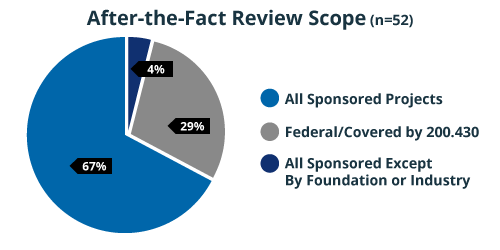

Of 52 Cohort institutional responses, 21 have implemented or are actively planning to implement an alternative to effort reporting. 7 determined to stay with effort reporting and 24 are continuing to evaluate options. During the time of the Phase I survey (completed in January 2017), no member institutions had transitioned. Since that time, 14-member institutions have transitioned to an alternative to effort reporting.
13 cohort or non-cohort institutions have or are in the process of transitioning with Huron’s Employee Compensation Compliance product for some version of an alternative to effort reporting.
All 4 FDP pilot institutions continue with their alternative for payroll certification. In addition, we identified 6 institutions that never used traditional effort reporting A-21 that passed audit.
These data cleary indicate a movement towards alternatives to effort reporting.
Other data points of interest for the after-the-fact review of the 52 survey respondents:
- Basis of Review: 14 Project based, 33 have an institutional cycle and 3 were other (2 null)
- Institutional Cycle Intervals: 9 Annually, 9 Semester, 6 Semi-Annually, 6 Quarterly, 1 Monthly and 2 other (33 total).
- Who Performs the Review: 28 Only the PI Reviews, 10 Individuals Review Own and the PI, 4 Project Personnel Review their Own, 4 Other, and 3 Faculty review their own (PI rest) (3 null)
- Type of Review: 31 require a Certification, 17 are a Confirmation, 1 Other (3 null).
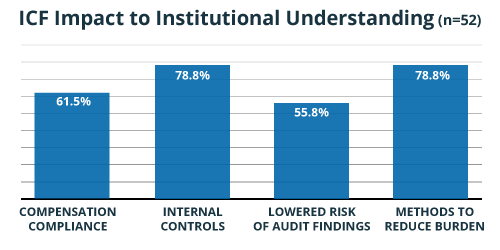
- # of additional payroll review controls: 22 have reconciliation reports and 34 provide compensation reports (institutions could require both).
- 11 institutions indicated these controls require approval and 28 indicated they were for informational purposes.
UT Dallas (Spring 2018):
| STATISTICS |
Effort Reporting processed |
Compensation Confirmations Processed |
# Not Certified on Time |
% Not Certified on Time |
Notes |
|---|---|---|---|---|---|
| FY14 | 1837 | 0 | 139 | 7.57% | |
| FY15 | 2026 | 0 | 112 | 5.53% | |
| FY16 | 908 | 0 | 58 | 6.39% | 9/1/2015-2/29/2016 |
| PILOT | 0 | 297 | 46 | 6.39% | 3/1/2016-8/31/2016 |
| FY17 | 0 | 555 | 31 | 5.59% | |
| FY18 | 0 | 430 | 15 | 3.49% | Projects that ended as of May 2017 and Anniversary processing months September to May |
Michigan Tech:
| STATISTIC |
EFFORT REPORTING |
PROJECT PAYROLL CERTIFICATION |
|---|---|---|
| Certifications distrubuted per year | 6700 | 620 |
| % NOT returned on time | 55% | 0% |
| # NOT returned on time per year | 3685 | 1 |
| Average not returned on time per month | 307 | 0 |
Cohort Activities & Presentations
Agenda and minutes from the conference call on Tuesday, May 17 at 11.00 PST/12.00 MST/1.00 CST/2.00 EST
Agenda and minutes from the conference call on Tuesday, July 19 at 12.00 PST/1.00 MST/2.00 CST/3.00 EST:
Huron Webinar
NCURA Webinar
Cohort Workshop Slides – Institution Examples - 03/06/2018
Cohort Member Institutional Examples
Cohort Audit Community Engagement
Final Report of Paul J. Coleman, project consultant
Amendment to Paul J. Coleman to address HHS audit of UC Riverside
Franciosa & Associates Assessment of CERA Internal Control Framework
Ralph DeAcetis provided the following individual comments to the Internal Control Framework:
- The Internal Control Framework was excellent, it will facilitate an institution’s ability to objectively review and evaluate their internal controls related to compensation.
- Utilization of the ICF can help demonstrate to an auditor that an institution has a foundational understanding of best practice internal control policies and procedures related to salary distribution.
- Recommends the Cohort to institutions who are interested in exploring alternatives to traditional effort reporting, now that the requirement for individual certifications has been dropped (Cohort members have been recruited through his recommendations).
COGR NSF and NIH OIG Panel for Compensation Compliance – June 2018 (link to attached PDF Document)
Other Publications
- Johnson, Dorothy, “Investigation of Alternatives to Effort Reporting for the University of Wisconsin-Milwaukee”, A Capstone Paper Submitted to the Krieger School of Arts and Sciences Advanced Academic Programs in Partial Fulfillment of the Degree of Master of Science in Research Administration.
- Guilbeault, Jason, “Rethinking Effort Certification by Thinking Outside the Box - Is a Certification of Effort by Principal Investigators the Best Internal Control Over Compensation Charges?” NCURA Magazine, December 2017.
External Validations
Executive summary of 2 CFR 200.430:
National Dialogue Summary:
Cohort Model Policy:

Cohort Leadership is Powered By


Special Thanks to the University of Texas at Arlington for website development and hosting.
Please take a few minutes to read our Terms & Conditions and Privacy Policy